When Time Begins to Travel
At 10:59, a conventional dial is read almost instinctively. The minute hand is approaching twelve; the hour hand is nearing eleven. One hour is about to end, yet few of us pause to notice how that change takes place.
A wandering hour watch brings that usually unnoticed transition forward. The active hour moves along a minute track, drawing close to its end. As one hour gives way to the next, the change becomes part of what the wearer sees.
Time itself has not changed. What changes is the way its passage is shown.
This is the idea behind a wandering hour watch: not to make time harder to read, but to let movement take a visible place on the dial.
The Hour Moves. The Minutes Give It a Path.
A wandering hour watch does not use a central hour hand as its primary way of showing the hour. Instead, the active hour is carried by a moving element. Depending on the design, that element may be a rotating disc, a satellite-style carrier, or another mobile assembly. What the wearer sees is simple: the current hour travels across a minute scale.
The numeral tells you the hour; its position on the scale tells you the minutes. If the “8” is aligned with the 35-minute mark, the time is 8:35.
The internal construction can vary greatly from one watch to another. Wandering hours are not one single mechanical architecture, but a principle of display: the hour is no longer held still. It has a route.
The Moment an Hour Changes
What makes a wandering hour display memorable is not simply that a numeral moves across the dial. It is the changing of the hour itself. For nearly sixty minutes, one numeral follows its route. As it approaches the end of the scale, it quietly tells the wearer that this hour is nearing its close.
The precise mechanics of that handover differ from one design to another. But the reading principle remains clear: find the active hour, then follow it along the minute scale.
On a traditional watch, the hour hand is moving all the time, but the arrival of a new hour is easy to overlook. A wandering hour display gives that transition a more visible role. It is not drama for its own sake. It gives form to something every watch already does: one hour ending, and another beginning.
A Different Way to Read Time
The first encounter with a wandering hour watch may take a brief adjustment. Instead of looking for two central hands, you first locate the active hour numeral, then read its position against the minute scale. Once that relationship is understood, the process is direct.
You are not solving a puzzle each time you check your wrist. You are following one moving marker across one clear path. With use, this becomes a natural sequence of sight: hour first, minutes next.
That is why design matters so much. The active hour must be easy to identify. The minute scale must remain legible. Any visible mechanical structure should support the reading, rather than compete with it.
The dial is no longer only a surface for information. It becomes a space where mechanical movement is arranged, revealed, and kept readable.
The complexity belongs within the mechanism; the reading should remain clear on the dial.
The Challenge Behind the Display
A wandering hour display asks for a careful balance. The active hour needs to remain aligned with the minute scale, the following display needs to arrive at the appropriate moment, and the whole system must stay coordinated with the watch’s timekeeping mechanism.
The difficulty is not simply to make components move. It is to decide which movement deserves to be seen.
More visible layers can make a dial striking, but they can also make it harder to read. The minute scale may recede, the active hour may become difficult to find, and the pleasure of looking at the mechanism may begin to compete with the simple task of telling the time.
A considered wandering hour watch works with restraint. It allows the mechanism to remain present while keeping the wearer’s attention anchored to the current hour and the minute track.
The mechanism may be complex. The act of reading time should not feel complicated.
ATOWAK and Time in Motion
For ATOWAK, wandering hours are not merely an alternative to conventional hands. They are part of a broader exploration into non-traditional time display: how time can be organised on the wrist through movement, structure, and changing spatial relationships.
The intention is not to make time deliberately unfamiliar. It is to give mechanical motion a meaningful place in the experience of reading time.
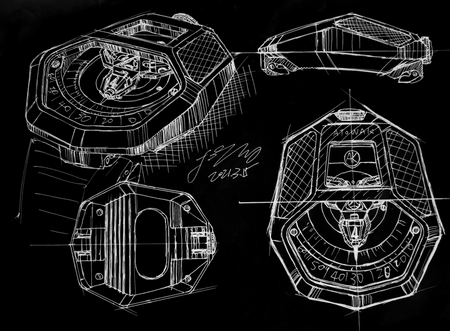
MANTA-X brings this idea into a fluid, sculptural form. Inspired by the streamlined shape of the manta ray, its design places mechanical structure and organic curves within the same field of view.
ATOWAK describes this relationship as Fluid Mechanism: a balance between power and flow, nature and engineering.
Within this language, the wandering-hour display is not an isolated feature added to the dial. It helps shape the way the watch is seen and read: movement remains present, structure remains visible, and time can still be clearly read.
It is not intended to make time unfamiliar, but to make its passage visible through mechanical motion.
More Than an Unusual Display
A wandering hour watch is not simply another way to show the hour. It reminds us that precision does not have to speak in only one visual language.
Time can remain exact while the movement behind its display becomes part of what we notice. The dial can remain clear while the structure beneath it is allowed to speak.
In a wandering hour watch, time is not only indicated. It travels.